
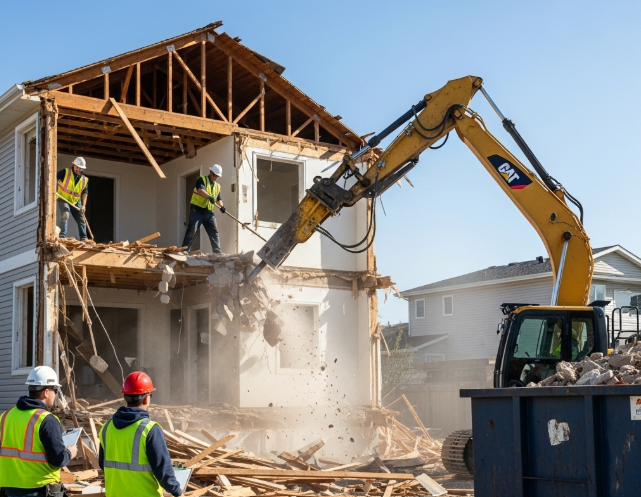
Watching a building come down can be mesmerizing, but if it’s a high-rise in New York City, it’s also nerve-wracking and complicated. From my experience, most people underestimate how much planning and preparation go into safely demolishing a tall structure. It’s not just about knocking down walls or swinging a wrecking ball. There’s an intricate process of planning, permitting, and safety measures that happens long before the first piece of concrete hits the ground. Professionals in demolition services in New York know how to navigate these challenges with precision and care.
High-rise demolition in a city setting is akin to trying to put together a giant jigsaw puzzle. Every floor, beam, and piece of debris has its importance. Any one slight misstep results in total pandemonium, not just in the building but on the streets around it. So every professional scene is mapped down to the last move; pedestrians, nearby buildings, traffic patterns, and even local events will be factored in. So much planning enables unstoppable execution of the project while ensuring the safety of everyone in its vicinity.
I’ve seen projects where tremendous planning worked wonders. Teams anticipate the unanticipated: hidden steel beams, uneven concrete floors, and even environmental issues like asbestos or lead paint. High-rise demolition in New York, when done right, can be very precise, very controlled, and even graceful. Here, we will look under the hood at the giant challenges demolition teams take on and what must go into a safe, well-coordinated tall building demolition.
Why High-Rise Demolition Is So Complex
High-rise demolition is far more complex than, say, house or small building demolition. They are tall and heavy and adjacent to other buildings that remain untouched. Each single maneuver is executed as a plan to prevent accidents.
Designed to last for several decades while withstanding wind and supporting multiple floors of weight, the building's dismantling requires strong equipment and methods. Add a bunch of other challenges of a dense urban environment, such as New York City, in which all the streets are packed to the curb, pedestrians walking in every direction, and subways everywhere, and magic might just happen by the way of complexity. Environmental considerations also come into play. Older structures could contain asbestos, and these must be removed in a harmless manner before demolition can commence.
So, from structural to logistical and environmental, this conclusion has made high-rise demolition a severely specialized field. It's not about brute force. It's about strategy, precision, and patience. The demolition professionals in New York understand these challenges well and have the experience to carry them out safely and efficiently.
How Do Professionals Plan for High-Rise Demolition?
Planning is where the bulk of the work happens. Before any tools arrive on site, the demolition crews spend weeks preparing and laying out the project.
First, they will conduct a detailed site survey. Engineers will check the building for structural weaknesses, the presence of hazardous materials, hazards that can affect the health of workers, or any other safety risks. Permits are obtained from the city agencies that enforce local land use regulations to ensure that the project complies with all such rights. Safety measures such as scaffolding installations, barriers, and dust suppression would be in place. The scheduling of the project will even be coordinated with respect to traffic, local events, and weather.
A high-rise demolition would become chaotic and unsafe in New York without this meticulous planning. Professionals think of a problem before it arises; that is why projects in the city usually proceed smoothly. This is the sort of planning that separates a professional operation from an amateur attempt.
What Methods Are Used in High-Rise Demolition?
High-rise demolition isn’t one-size-fits-all. Depending on the building and location, contractors may use several methods to bring a structure down safely.
Piece-by-Piece Dismantling
This is the most common method in densely populated areas. Crews use cranes and excavators to remove sections from the top down. It’s slow, but extremely safe, and allows for control over debris.
Implosion
This method uses controlled explosives to bring a building down quickly. While dramatic, implosions are rarely used in New York due to nearby structures, making them a rare but powerful option.
High-Reach Excavators
These machines can reach multiple stories and break down steel and concrete without needing large cranes. They are particularly useful for medium-sized high-rises.
Hybrid Approaches
Often, demolition crews combine methods. They might dismantle the upper floors manually while using machines for the lower levels. This flexibility allows them to adapt to unexpected obstacles.
How Do Crews Handle Safety Concerns?
Safety is the top priority on any high-rise demolition project. The risks are real, from falling debris to structural instability.
Barriers and scaffolding prevent debris from reaching the street or nearby buildings. Dust suppression systems reduce air pollutants that could harm workers and residents. Every crew member is trained in both demolition and emergency response. Sensors monitor air quality, structural movement, and other hazards in real-time.
From my observations, safety becomes second nature to experienced crews. They think about every detail, from securing scaffolds to double-checking machinery, ensuring that no one is put at unnecessary risk.
What Are the Biggest Challenges in High-Rise Demolition?
High-rise demolition comes with unique obstacles that smaller projects don’t face.
- Tight Spaces: Removing a building in a dense city requires precise movements. There’s no room for error.
- Noise and Disruption: Demolition is loud and can disturb residents. Teams often have to work within specific hours to reduce complaints.
- Waste Management: High-rises produce massive amounts of debris. Coordinating trucks, recycling, and disposal is a challenge in a busy city.
- Unpredictable Surprises: Even with thorough planning, crews may discover hidden steel beams, asbestos, or structural irregularities that require quick adjustments.
How Do They Minimize Environmental Impact?
Modern demolition focuses on recycling and deconstruction. Steel, concrete, and wood are separated and repurposed. Concrete is crushed for new construction, metal is recycled, and wood or glass is reused or donated.
New York demolition services are the frontrunners in employing green practices. Salvaged materials are often used in local projects, and minimizing landfill waste is paramount. Reuse and recycle earn some points in limiting the environmental impact while lowering disposal costs.
How Technology Shapes High-Rise Demolition
Technology has changed the landscape of demolition.
With 3D models, crews can simulate the demolition process and test strategies in a safe environment. Drones allow for inspections from the air, helping engineers assess areas that are hard to reach. Remote-controlled machines can perform unsafe tasks so that workers are kept out of harm's way. Sensors assess vibrations, air quality, and structural stability in real time, providing instant feedback.
Technological advancements merged with practical knowledge make the high-rise demolition works in New York safe and efficient.
How Do Crews Work Around the “City That Never Sleeps”?
The city works day and night. This is a basic truth that demolition crews must accept. Night work or weekend work might be needed to mitigate traffic and pedestrian congestion. Truck routes are so very carefully planned; coordination is given with city agencies with respect to other transit disruptions in oppositional directions to civic disruptions in public life.
A real balancing act occurs. The teams need to be very flexible, very reactive, and very strategic. It is almost a dance where timing and precision matter.
The Role of Experience and Teamwork
Time andagainin I have heard that the core competencies of demolition work are working together and teamwork; no matter how many resources and equipment we put in place, if the crew is not coordinated in the field, it will never be able to deliver the result.
Supervisors, crane operators, and laborers are all anticipating what the other is going to do. It's very impressive watching a top-level demolition crew. They all know exactly what to do; they all communicate well together; and they all make good decisions when faced with unexpected events. Teamwork makes what would otherwise be a high-risk operation into a controllable and efficient one.
FAQs
Q1: How long does it take to demolish a high-rise in New York?
Most high-rise demolitions take several months, including preparation, permits, and cleanup.
Q2: Can demolitions be done safely near other buildings?
Yes. Protective systems, careful planning, and experienced crews ensure adjacent structures remain unharmed.
Q3: Is implosion commonly used in New York?
No. Implosions are rare due to the density of the city. Most projects use piece-by-piece dismantling.
Q4: What happens to all the debris?
Materials like steel, concrete, and wood are sorted, recycled, or donated whenever possible.
Q5: Why is high-rise demolition more expensive in New York?
Labor, logistics, safety measures, and navigating a dense urban environment drive costs higher than in less crowded areas.
Resources
- NYC Department of Buildings – Demolition Regulations
- Local recycling and waste management centers in New York
- National Demolition Association
Conclusion
Demolishing a 10-15-story building is about a lot more than just tearing down walls. It has aspects of planning, safety, teamwork, and technology. All steps, which include inspection, permits, debris management, and environmental considerations, count.
If you are planning to demolish a high-rise building, you must choose to work with demolition services in New York. Their understanding and precision of city codes guarantee that the work is done safely and efficiently. Starting with a trusted professional could really work well in making a complex project manageable, predictable, and even enjoyable to watch.